Every facility has unique air quality, humidity, and temperature requirements. We start with your application parameters and engineer a system that meets them precisely — not an oversized catalog product that wastes energy and budget.
Discuss Your Project
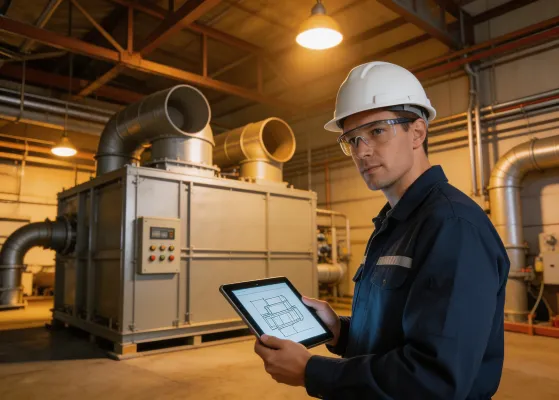
Select your facility type to see how AirPure engineers design air treatment systems for your specific operating conditions.
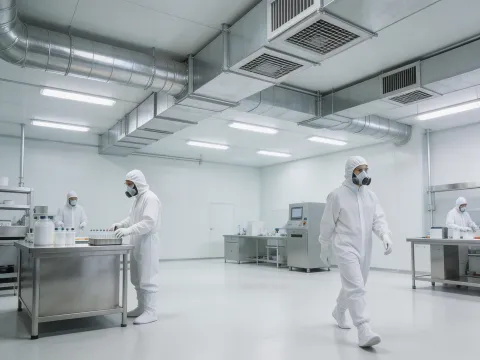
Challenge: Maintaining ISO 14644 Class 5-8 cleanroom standards with precise temperature (20-22°C ±0.5), humidity (45% ±5% RH), and positive pressure cascade across production zones.
Our Approach: AirPure AHUs for pharmaceutical applications incorporate HEPA H14 terminal filtration, stainless steel or powder-coated aluminum interiors for GMP compliance, and redundant fan systems for continuous operation. Integrated BMS connectivity enables real-time monitoring of particle counts, differential pressure, and temperature at every zone.
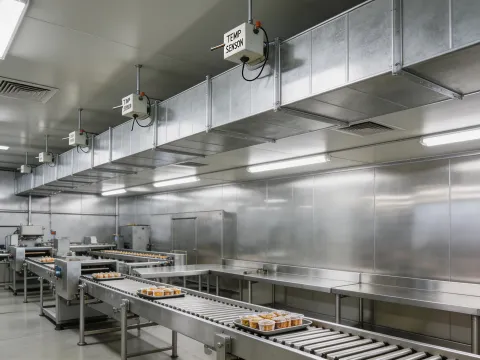
Challenge: Preventing condensation, microbial growth, and cross-contamination in temperature-controlled production areas while meeting HACCP and FDA 21 CFR Part 110 requirements.
Our Approach: HACCP-compatible dehumidification systems with stainless steel construction, condensation prevention engineering, and washdown-ready components. Desiccant dehumidifiers maintain low dew points in chocolate, confectionery, and frozen food production lines where moisture directly impacts product quality.
Challenge: Maintaining server inlet temperatures of 18-27°C and 40-60% RH per ASHRAE TC 9.9 guidelines, while minimizing PUE and maximizing free cooling hours.
Our Approach: Precision air handling units with economizer-first control strategies that maximize free cooling hours. Variable airflow with EC fans, evaporative cooling stages, and hot/cold aisle containment-optimized discharge patterns. Real-time monitoring integrates with DCIM platforms for capacity planning and PUE tracking.
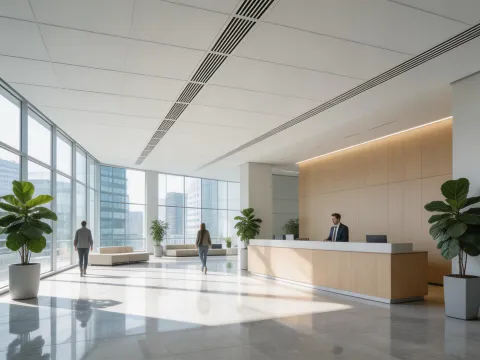
Challenge: Balancing occupant thermal comfort and indoor air quality with energy performance targets (ASHRAE 62.1, EN 16798) in offices, hotels, hospitals, and retail environments.
Our Approach: Fan coil units and central AHU systems with demand-controlled ventilation (DCV), CO2-based occupancy sensing, and enthalpy recovery wheels. Our modular AHU platform allows future capacity expansion without replacing the entire unit.
Choosing the right air treatment approach requires evaluating trade-offs across multiple technical and economic dimensions.
| Selection Dimension | Key Considerations | Typical Impact |
|---|---|---|
| Energy Recovery Method | Rotary wheels offer 80-85% total efficiency but carry 1-3% cross-contamination risk. Plate exchangers eliminate contamination but max out at 60-75% sensible recovery. Run-around coils suit physically separated supply/exhaust paths with 45-55% efficiency. | Energy cost difference of 20-35% between methods for the same building over a 15-year lifecycle. |
| Fan Motor Technology | EC (electronically commutated) motors achieve IE5 efficiency class and allow stepless speed control. AC induction motors (IE3/IE4) cost 30-40% less upfront. Breakeven on EC investment typically occurs at 3,000-4,000 annual operating hours. | EC motors reduce fan energy by 30-50% at part load compared to AC motors with on/off control. |
| Humidity Control Precision | Steam humidifiers deliver ±2% RH accuracy but consume 750 Wh per kg of steam. Evaporative (adiabatic) humidifiers use only fan energy but achieve ±5-8% RH and introduce water treatment requirements. Ultrasonic humidifiers sit between at ±3% RH with moderate energy use. | Operating cost difference of 3-8x between steam and adiabatic methods for equivalent moisture output. |
| Filtration Grade vs. Operating Cost | Each filter class upgrade (e.g., F7 to F9, or F9 to H13) adds 100-300 Pa pressure drop, increasing fan power. Over a filter's service life, energy cost typically exceeds the filter purchase price by 5-10x. | Specify based on ISO 16890 minimum efficiency requirements for your application, not as a general precaution. |
Our application engineers have configured air treatment systems for over 2,000 facilities across 85+ countries. Share your requirements and we will recommend the optimal approach within 48 hours.
Start Your Free Assessment